

The Institute Hosts an Academic Lecture on Research Frontiers in the World Economy and International Trade and Academic Writing
To help faculty and students understand emerging research directions in the world economy and international trade, develop sound academic writing skills, and strengthen their capacity for innovative research and publication, the China Institute for WTO Studies invited Lin Jingli of the Fujian Academy of Social Sciences to deliver a specialized lecture on November 2, 2026. More than 30 faculty members and students in relevant fields attended.
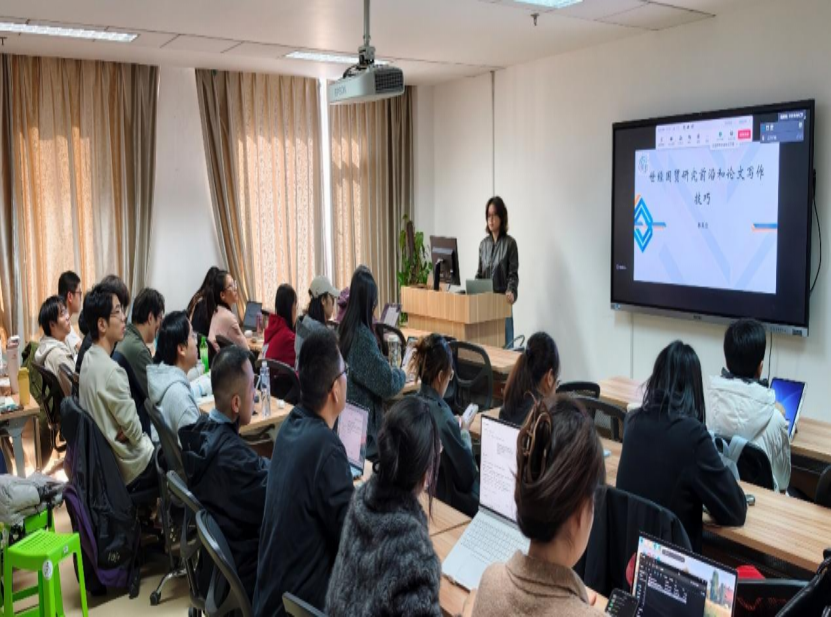
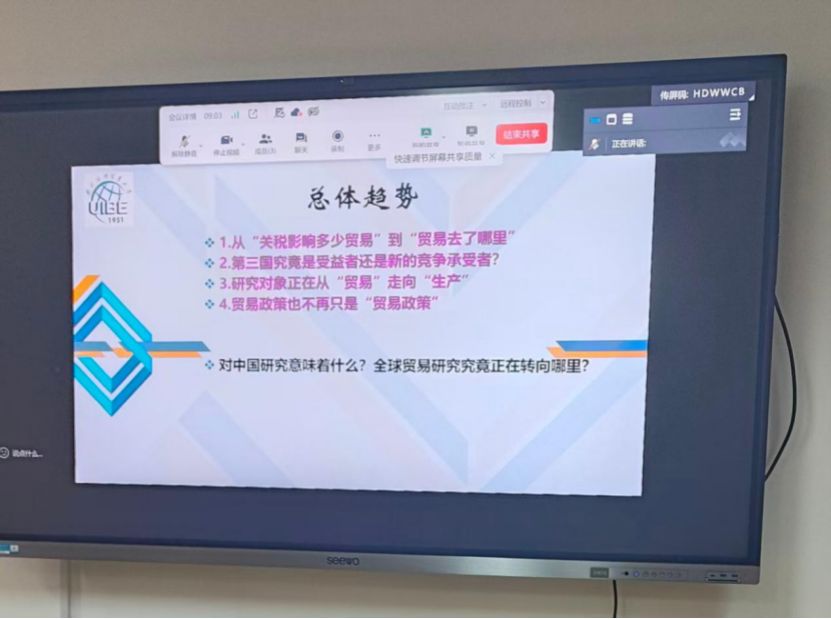
The lecture focused on research frontiers in the world economy and international trade, as well as academic writing. Lin reviewed broad developments in international trade research, noting a shift from examining how tariffs affect trade volumes to explaining the drivers of trade flows. Research has also expanded from trade transactions to stages of global production, while the scope of trade policy analysis has continued to broaden. Drawing on China’s economic and trade development, Lin identified promising topics for further study, including the economic effects of Chinese exports to third countries, the roles those countries play, Chinese firms’ responses to trade barriers, the impact of global production restructuring on domestic production, and the measurement of geoeconomic risks. The lecture also assessed the state of research in China. Although Chinese scholars account for a substantial share of publications in leading international journals, relatively few papers are authored solely by mainland-based scholars, leaving room to strengthen their academic influence. International journals are publishing fewer purely theoretical papers, with research combining theory and empirical analysis becoming mainstream. Detailed customs bills of lading, shipping, and supply-chain data are increasingly used, while Chinese researchers still have scope to make greater use of new forms of micro-level data.
In the academic writing session, Lin discussed the full process of producing a research paper. Titles, abstracts, and keywords are crucial to submission: titles should be concise and engaging; abstracts should objectively explain the research question, methods, main findings, and contribution; and keywords should use technical noun phrases that closely match the topic. Lin emphasized that a literature review is an academic conversation rather than a list of references. He recommended a three-part structure covering consensus, debate, and research gaps, organized by theme to synthesize the research frontier and identify unanswered questions. He cautioned against merely listing others’ views or overlooking foreign-language literature.
Lin also outlined three core academic writing skills. Literature reviews should be precise, sharply focused, and concise, classifying and evaluating existing studies to identify the research gap. Arguments should be supported by a complete body of evidence, with facts, data, and literature reinforcing one another logically. Language should remain rigorous, restrained, and academic, avoiding slogans and emotional rhetoric. He also distinguished research papers from commentary on current affairs: description is only the starting point, while analysis and explanation are the defining strengths of academic research. Reports and opinion pieces should therefore not be treated as equivalent to research papers.
Combining insights into current theory with practical research advice, the lecture explored promising research directions and offered guidance on the full writing process, from choosing a topic and drafting a paper to submission and revision. It provided students with valuable inspiration and practical direction for their future academic work.