

How Standards Connect the World: The Institute Hosts a Lecture on Standards Connectivity and High-standard Opening-up
Standards do far more than harmonize technical specifications: they serve as a “passport” for goods moving across borders and are an important vehicle for institutional opening-up. On the afternoon of October 16, Dr. Wang Yanyan, a lecturer at the School of Economics and Management, China University of Geosciences (Beijing), visited Room 505 of the Research Building. In a talk entitled “Standards Connectivity and High-standard Opening-up: Evidence from China’s Trade and Investment,” she shared a series of studies examining the links among standards, trade, and investment.
The lecture presented three studies that progressively developed a comprehensive account of how standards influence opening-up.
The first study examined international standards adoption and firms’ market expansion. Dr. Wang constructed an index of efficiency in adopting international standards and found that adoption can lower industry productivity thresholds and facilitate the integration of domestic and foreign trade, helping firms expand into international markets. She also advised students to use theoretical models carefully: when difficulties arise in deriving a model, researchers should return to the original English-language text and study it closely rather than rely on secondhand accounts.
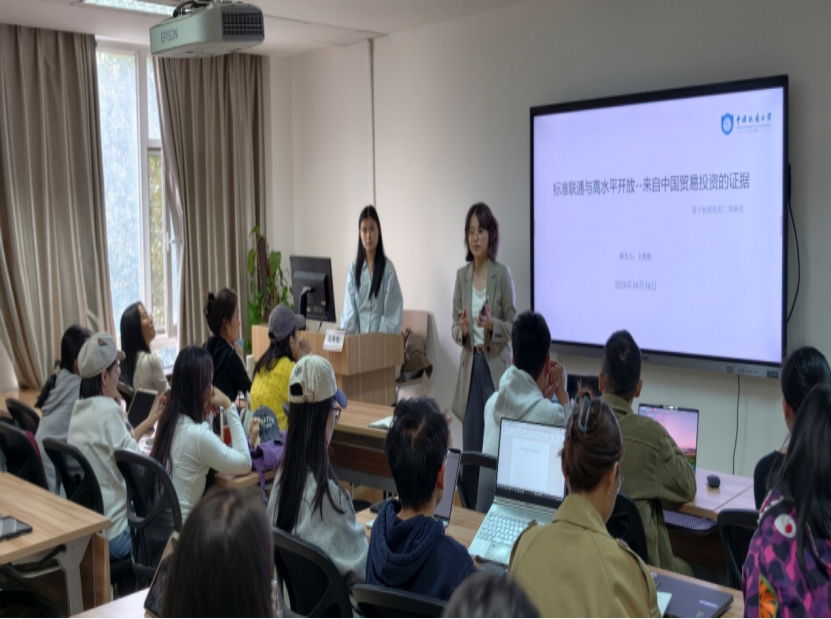
The second study turned to Chinese standards themselves. Treating the publication of foreign-language versions of national standards as a policy shock and using product-level export data, Dr. Wang identified a positive effect of the international dissemination of Chinese standards on export competitiveness. The underlying mechanisms involve technological improvements and information provision: publishing standards in other languages encourages product quality upgrading while helping overseas buyers understand Chinese products.
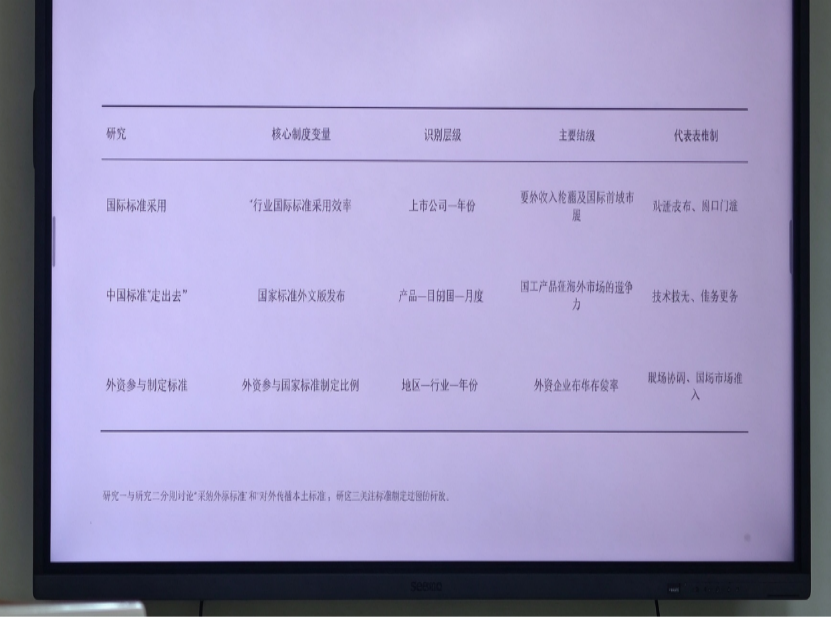
The third study asked how institutional opening-up can help retain foreign investment. Examining the effects of foreign-invested firms’ participation in setting Chinese standards on their survival in China, Dr. Wang found that such participation significantly extended their operating lives through three channels: greater alignment between domestic and international standards, deeper integration into the domestic economic circulation, and the localization of technology.
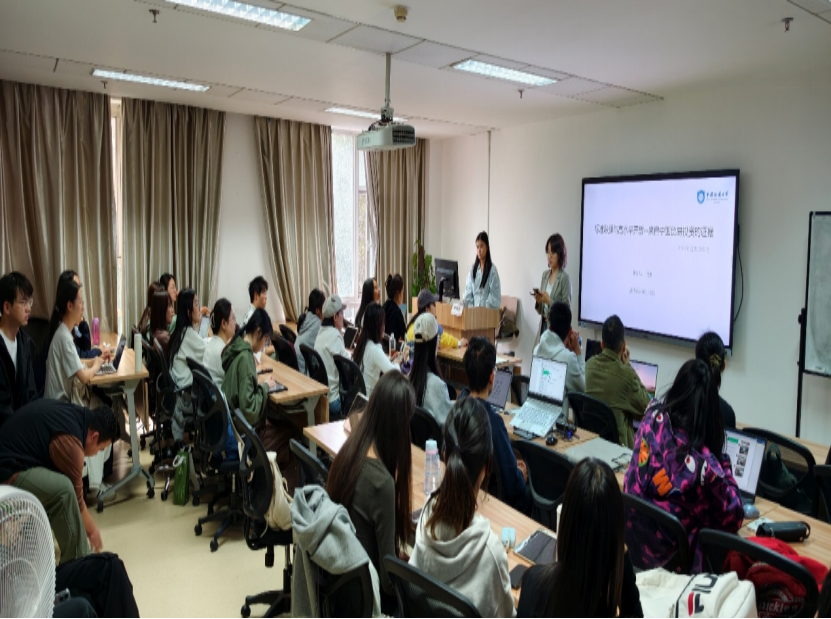
Together, the three studies formed an integrated framework linking standards, trade, and investment. Standards influence firms’ exports, exports support product competitiveness, and deeper involvement in standards-setting in turn affects whether foreign-invested firms remain in the market. Dr. Wang concluded that standards play a strategic role in institutional opening-up and deserve close attention in the design of policies for high-standard opening-up.
The lecture provided solid empirical evidence of the economic value of standards and offered faculty and students new ideas for research in related fields.