A successful panel on China-Africa economic relations at 2014 WTO Public Forum
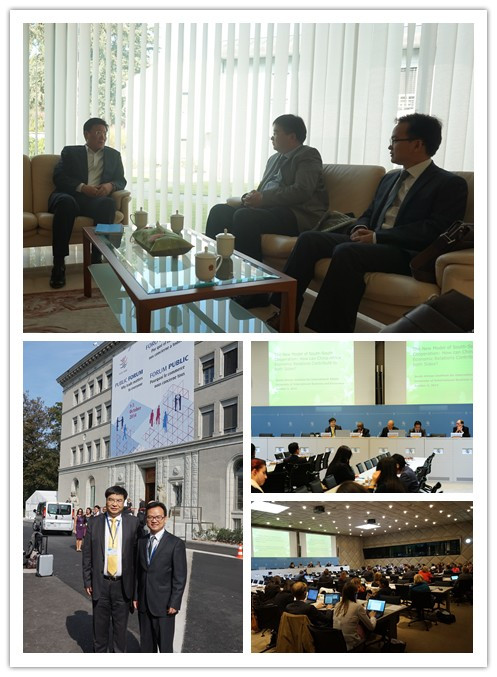
2014 WTO Public Forum was held at the headquarter of the WTO in Geneva from 1 to 3 October 2014. The theme of this year is why trade matters to everyone. More than one thousand participants were present at 68 sessions on different topics. UN Secretary General Ban Ki-moon and WTO Director-General Roberto Azevêdo attended the opening session.
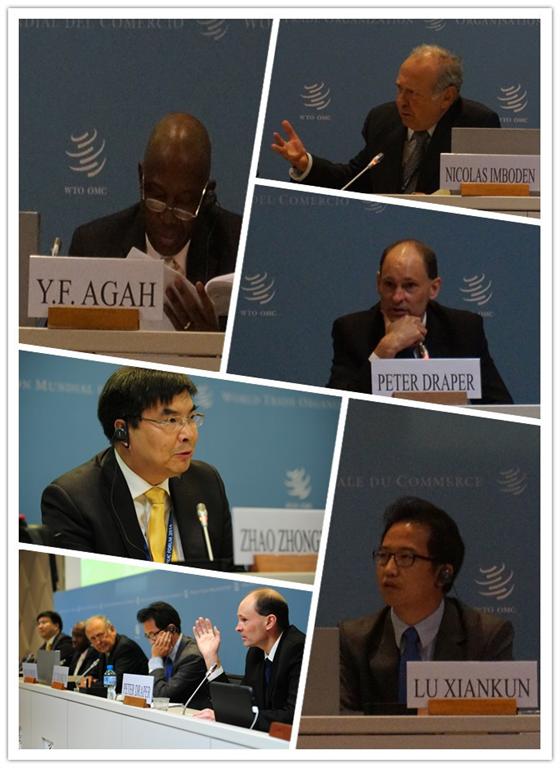
The China Institute for WTO Studies of UIBE and South African Institute for International Affairs (SAIIA) co-organized a session titled “The new model of South-South cooperation: How can China-Africa Economic Relations Contribute to both sides?”, which aimed to discuss the fast developing economic relationship between China and Africa and its meaning for both sides. We invited four distinguished panelists who are WTO DDG Yonov Frederick Agah, Senior Research Fellow with SAIIA Peter Draper, Executive Director of IDEAS Centre Nicolas Imboden, Counsellor of Chinese WTO Delegation LU Xiankun. The panel was moderated by Vice President of UIBE ZHAO Zhongxiu. The panel highly praised the achievements of China-Africa economic relations and objectively pointed out their shortcomings and made a number of positive suggestions. The discussions were much welcome by the audience.
Below are summaries of their speeches.
(a) Peter Draper, Senior Research Fellow, South African Institute for International Affairs (SAIIA)
Mr Draper recalled an article Changing China and changing Africa contours an emerging relationship which published by the Asian Economic Policy Review to give a brief outline of the topic. According to Mr Draper, the discussion of the structure of Africa and China relations should depend on reviews of various elements of those broad architecture relations from prick valence security relations through culture relations to social relations besides economic.
Mr Draper identified profound changing of both China and the Africa when it comes to the economic component. He pointed out three key phenomenon of China ’s changing and two of the Africa . Firstly, cost structure in China is rising which causes the relocation of global value chains, particularly the laboring tense of aspects of global value chains. Its first instance effect is surrounding Asia, affects countries like the Vietnam . He noted that this could give Africa the opportunity to down the line to plug into global value chain. Secondly, the reorientation of China ’s focusing on the export to the domestic market, additionally the parallel development of the services economy as through the establishment of the Shanghai Free Zone or the efforts to join the TiSA Agreements in the WTO. The third change is the transition away from resource acquisition to domestic environmental concerns, which suggests less source usage down the line from the Africa . As for the Africa , first one is its secular economic expansion. It enjoys interest not just from China , but from the US , Brazil and India . By no means even there are conflicts remaining in many countries. This economic expansion partly depends on the resource export, but also due to the demographic expansions or the emerging demographic dividend. According to UN’s projection, by the end of this century, the Africa as a whole will contribute the second largest population across the world.
Mr Draper suggested that although Nigeria is not likely to be the equivalent of China , it is likely to have a much bigger young and productive workforce. The phenomenon of the rising of urban middle classes, so as the consumer markets can be the best proof.
Answering the question of how to make an economic interaction of China and Africa from each side, he noted that outward FDI from China led by state-owned enterprises which mainly focus on resource acquisition is going to diminish relatively in the future, while private sector component of Chinese outward FDI is going to increase. From diplomacy point of view, he encouraged supporting Chinese private sector in its expansion in Africa economy. Such as opening up of different ranges of sectors for Chinese investment into Africa connected to the middle class story. From the economic diplomacy side is about the rules of the game. He suggested China to invest in the African government for only good governance can secure private sector interests. Meanwhile, bilateral investment treaty can secure the FDI. According to Mr Draper ,the countries that would benefit could be those have large populations, large work forces, relatively cheap labor or perhaps coastal locations. If African countries want to attract MNCs ,they should in favor of the path of trade openness. However, some countries is now on the counter side for revoking investment treaties.It remains to see how they place themselves out.
(b)Yonov Frederick Agah, Deputy Director-General, World Trade Organization (WTO)
Answering the question of whether is there a new model of south-south cooperation, Mr Agah gave a no. However, he noted that China and Africa have a long history of friendship and exchange since Egypt began to receive Chinese develop assistant in 1956 as the first African country.
Mr Agah discussed the topic in three elements; those were blaming in the trade and investment relationship between China and Africa , the role of china in the WTO and some other concluding remarks.
Firstly,he stressed from the outside to identify that china’s growth development is good for the global economy, especially positive effects on developing economies. He presented evidence such as China ’s committed 75 billion US dollars 1700 projects spreading in fifty African countries and some other statistics to prove the fact that investment in Africa increased a lot for the past decades. Meanwhile, he noted four reasons for the remarkable mounting of African’s share in Chinese import. First, China joining the WTO brought market access opportunities for the African countries. Second, China actively source to further improve access for African countries such as duty free quota free and some other special plan on trade. China is still expanding program of trade-related assistance by means of opening forum for Africa , notably the China-Africa cooperation created in 2000. Mr Agah then went through evidence of special loan for small and medium sized African businesses. Finally, he pointed out aid promote trade facilitation, and highlighted that Africa should provide competitive investment incentives and address some concerns regarding skills in the labor forces, therefore they will have a historical opportunity to attract Chinese investment. He also presented the green relationship between China the African union and other regional economic communities in many fields.
Secondly, Mr Agah suggested the role of China in the WTO, particularly stress on two aids for trade may have effects on the relationship. He looked forward to china’s active engagement in the next global review of aid for trade in 2015.According to him, China the Africa should solidify and enhance the cooperation in the WTO by keeping the negotiations in the WTO alive and ensuring successful and strong multilateral trading system.
Finally, Mr Agah concluded remarks by answering questions about china’s motives in Africa . From his point of view, we should judge China based on the principles that presented by Premier Zhou when he visited Africa in 1963.The principles were basically depend on the quality. He suggested China to help the African countries to achieve self-reliance on the independent government without having special demands or enjoy any special amenities.
(c)Nicolas Imboden, Executive Director, International trade, Development, Economic governance and Advisory Services (IDEAS Centre)
Mr. Imboden made some comments about the China-Africa relationship as an observer. He clearly pointed out the China ’s engagement in Africa is beneficial to Africa beyond any doubt. First, China ’s demand for resources from Africa contributes to the actual GDP growth of Africa . Second, China also contributes to the increasing competition both in supply and investment of Africa and it makes Africa benefit from the cheap cost and higher return. The third is that China is showing faith in Africa and viewing Africa as “Continent of the future” rather than “Last continent” and willing to take the risk to make this future realistic, which make the world to rethink the great opportunities lies in the Africa with the great demand and huge capacity of labor could provide in the global value chain.
Mr. Imboden compared the ways China doing things in Africa with other countries using a story told by the Ambassador of Mali about the bridge building. China did make big announcement like other countries, however, China delivered their promising and did it fast while other countries didn’t, though China might oversee some environmental or labor risk. The key reason China is being attack is that China don’t segment its aid and business, therefore makes people judge China’s behavior in Africa with both the criteria of aid and business. According to Mr. Imboden, China did things like helping Africa to develop its natural resources may not seem right in views of aid but quite reasonable in views of business. He further gave some statistics about the infrastructure such as railways and roads and hydroelectric power building by China to prove that China showing commitment to the long term development of Africa. He also noted that China did most things just base on their comparative advantages and so less investment in education or so on didn’t mean China do anything wrong. However, he noted that China might care less about the value of the government and which might be not good for the long term sustainable relationship with the people.
At the last of his speech, he gave some suggestion for China to improve its relationship with Africa. First is to diversify its trading product and trading partner rather than concentrate in some countries. Secondly, is China should using more local contents and local talents in their projects. The third one is China should care more about the environmental and labor issue and try to improve the quality of their work. Mr. Imboden raised a concern about the illegal Chinese immigrant in Africa which might cause tension between local people with China.
(d)Lu Xiankun, Counsellor and Head of Division of Permanent Mission of China to the World Trade Organization (WTO)
Mr.Lu Xian Kun recalled the history of China-Africa relationship both in ancient Egypt and Ming dynasty of China using the story of silk road with Queen Cleopatra and anecdote of giraffe in the expeditionary voyages of Zheng-He. Mr.Lu noted that the development of modern China-Africa relationship is quite remarkable since Premier Zhou visited Africa in 1963. The news about Africa is attracting more and more French speaking Chinese students to work there and over 200,000 African living in Guangzhou city of China is evidence for that.
Then he introduced his opinion on China-Africa relationship in four aspects. First, China-Africa relationship is comprehensive which includes both the trade and investment. China is the largest trade partner of Africa since 2009, the bilateral trade grew 1.4 times in 2009 to 2013, while Africa is the fourth largest invest destination of China with a 24% growth rate annually from 2009 to 2013. Over 3000 Chinese MNCs is operating in 52 African countries such as Mali Uganda and Ethiopia and producing in lots of industry including sugar, glass, leather, medical capsule, vehicle and textile. Mr.Lu admitted that China do need the resources such as mineral and primary goods of Africa so about 80% of investment go the primary sectors just like the EU and the US and any other country else. The reason is that due to the capacity constrain the primary goods and resources are something Africa is producing and selling. But the trend is changing and about 50% of investment of China goes to manufacturing sector and 20% in the finance sector in recent years. China also invests in agricultural and devotes to the agriculture technology transferring. The China-Africa relationships not only benefit to the countries with diplomatic relationship with China but also indirectly benefit other countries which don’t have diplomatic relationship with China like Burkina Faso. Aside from the trade and investment, China also provides foreign aid for Africa in infrastructure such as building and electric power and talent education such as full scholarship for 30,000 Africa students studying in China.
After reviewed the China’s doing in Africa, Mr.Lu offered prospect about the China-Africa relationship. From the global value chain’s point of view, Mr.Lu saying that with the 150 million workers employed in China. The upgrading of China’s value chain requires the reallocation of the product with the same amount of labor and only Africa can take it. So the future of the China-Africa relationship is good.
As the China-Africa relationship could be marked as new mode of south-south relationship, Mr.Lu says No. What China is doing is not bad, but not perfect. And China is still a beneficial country of foreign aid from New Zealand, Switzerland, Norway and other EU countries. What China is giving to Africa is quite similar to what China is getting from other countries. Though China might do things in different approach due to her between role but it is still a north-south mode. China plays a cooperation partner role rather than a donor .However, China will learn from other donors and try to do things more efficient with its experience as a beneficial countries. Mr.Lu noted China is just copying the traditional north-south cooperation into this south-south cooperation. He thought China is doing good things and in a right direction but beyond perfect due to lots of factors such as lack of transparency and insufficient governance. Mr.Lu further explained China will not want to impose something to other countries during the cooperation because we experience it and feel about it.
At the last part Mr.Lu proposed some ideas about how to improve the China-Africa relationship and suggested listening to each other and learns from each other. He also admitted that some problems are valid such as environmental concern and social-labor issues and bringing too many Chinese to Africa. However, China is still a developing country; the international organization could do more things.