

Delegation of the EU to China Visits UIBE; EU-China Public Lecture Series in China Held
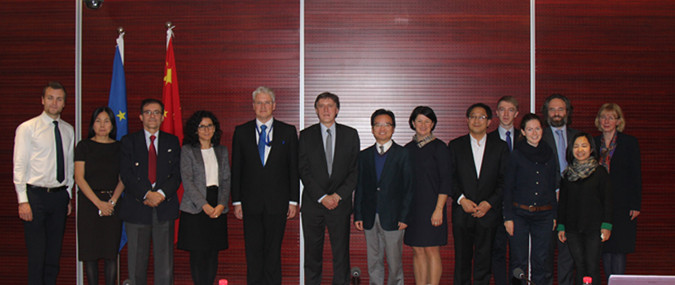
On November 9, the EU-China Public Lecture Series in China was held at the Council meeting room of Yifu Research Side Building at UIBE, co-organized by China Society for World Trade Organization Studies and China Institute for WTO Studies, UIBE. More than 60 people attended the event, including Mr. Ulrich Weigl, Minister Counsellor and Head of the Trade Section at the Delegation of the European Union to China, Dr. Duncan Freeman, Senior Research Fellow at the EU-China Research Centre of the College of Europe, Prof. Zhao Zhongxiu, Vice President of UIBE, and Prof. Tu Xinquan, Dean of CIWTO, UIBE.
Prof. Zhao Zhongxiu, Vice President of UIBE, gave a welcoming speech. He highlighted the significance of this lecture which provided insights on the current changes of the Chinese economy that could be seen more clearly by experts outside China. Identifying and understanding the changes and trends would be a starting point for China and EU to adjust to future changes. UIBE enjoyed very good connection with EU and hosted many EU-related events in our campus. Many experts and scholars from EU had visited and delivered speeches. This lecture would deepen our understanding on the current situation of the Chinese economy, the future of China-EU cooperation and on the global economic structure. 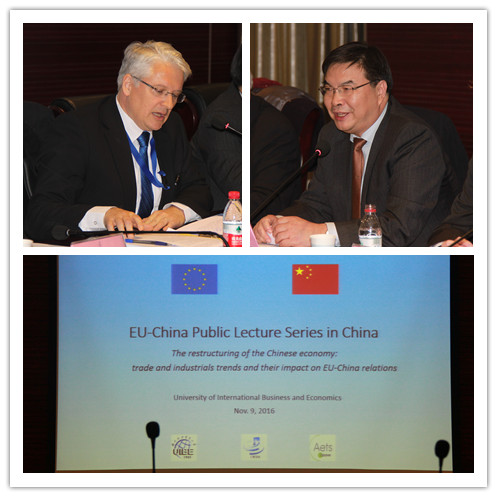 Mr. Ulrich Weigl, Minister Counsellor and Head of the Trade Section at the Delegation of the European Union to China, delivered a keynote speech on cooperation between EU and China. He noted that EU-China relationship had achieved significant progress during the past 40 years. The opening of EU market to China contributed greatly to the transformation and fast growth of the Chinese economy. Since the establishment of strategic partnership between EU and China, cooperation and interdependence between the two economies had been extended and deepened in various areas. The EU-China Strategic Agenda 2020 for Cooperation, established on the basis of respect and trust, had broadened and consolidated the EU-China strategic partnership and would continue to promote economic and cultural exchanges between the two economies. Following Mr. Weigl’s speech, Dr. Duncan Freeman, Senior Research Fellow at the EU-China Research Centre of the College of Europe, gave a lecture about Restructuring of The Chinese Economy: Trade and Investment Trends and Their Impact on EU-China Relations. Using charts and figures, he presented the changes and trends of the world economy, the Chinese economy and EU-China economic relationship. He elaborated the changes in goods trade and foreign direct investment of both EU and China and pointed out that China had increasingly contributed to the global trade in goods and large amount of goods trade between EU and China remained a core of EU-China relationship. He showed that compared with EU’s investments to the U.S. and Switzerland, its investment in China was relatively low and there was much potential that could be fulfilled in mutual investments between EU and China. Changes in China would bring changes to both EU and the world economy, including the “New Normal” growth and structural changes of the Chinese economy. Based on an analysis on changes of EU and China in service trade, finance and other new areas, he pointed out that the EU-China relationship was no-longer confined within traditional areas of trade in goods. Emerging dimensions created possibilities of a stronger, more balanced relationship, but require institutional support from both sides. In the Q&A session, Mr. Weigl and Dr. Freeman welcomed and answered several questions from the audiences, from provisions in the FTAs of the EU to the impact of BREXIT.
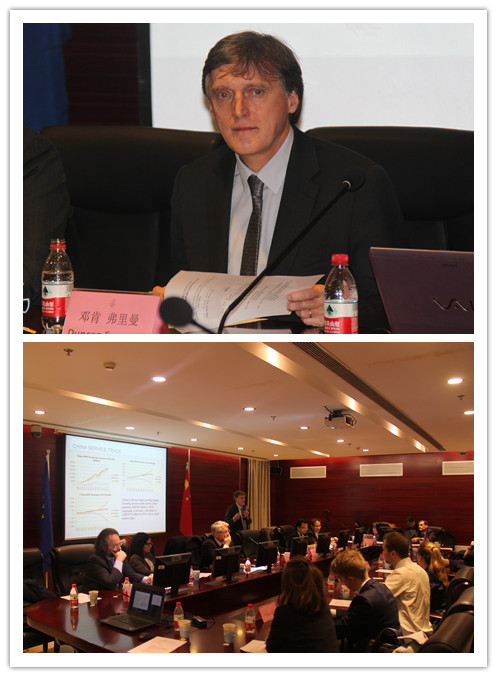 Prof. Xinquan Tu, Dean of CIWTO, added a few comments at the end of the lecture. He said that both EU and China were getting used to a new world where lots of unexpected changes had happened, either positive or negative, for example, China’s rise as an international investor, or BREXIT and Trump’s election. Although there were some differences between EU and China, he believed that these differences could be addressed through more dialogues and communication. He also noted that we should be more patient with each other, for this process would take time.
  Contributor: Liu Xiaoxi, Liu Ying